What makes the Inishturk Bee Sanctuary different?
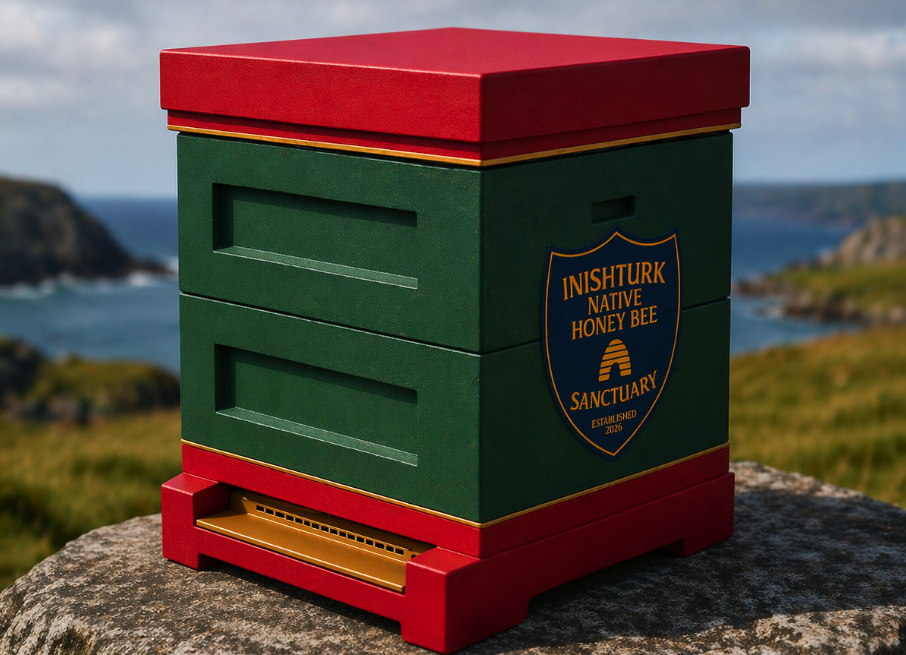
Q: What makes the Inishturk Bee Sanctuary different?
A:
A protected island sanctuary focused on the native Irish honey bee—slow, careful, and science-led. We prioritise bee health and biodiversity over scale.
Q: Where do the bees come from?
A:
From an experienced, ethical beekeeper in Spiddal, Co. Galway, with strong, well-managed colonies.
Q: What happens before bees arrive?
A:
All colonies are pre-treated with oxalic acid—a standard, effective method to reduce varroa before transport.
Q: How do you monitor hive health?
A:
Through regular “sugar roll” tests (a non-harmful way to check for varroa) and BroodMinder technology, which tracks temperature and humidity inside the hive. This allows us to compare hive performance with colonies on the mainland and internationally.
Q: What happens if varroa is detected?
A:
We respond immediately. The queen can be temporarily isolated to break the brood cycle (where varroa reproduce), reducing pressure naturally.
Q: Do you treat during the season?
A:
Yes, if needed. Based on monitoring, we can use thymol—a natural vapour treatment—to suppress varroa during the active season.
Q: What’s the end-of-season approach?
A:
If required, we use oxalic acid vaporisation when no brood is present—maximising effectiveness and helping reset colonies for the next year.
Q: Why not expand quickly?
A:
Because stability comes first. We only expand when existing colonies are healthy and as close to varroa-free as possible.
Q: How does this support biodiversity?
A:
Healthy native bees improve pollination and plant diversity. We also run pollinator surveys to measure and enhance impact.
Q: Will the local community be involved?
A:
Absolutely—training, education, and local participation are central to the sanctuary.
Q: Is this a commercial project?
A:
It may evolve into a social enterprise—but the core focus is conservation and protecting the native Irish honey bee.