NEW comparative data
Three Apiaries. Three Environments. One Ongoing Research Project.
Using Real-Time Data to Better Understand Ireland’s Native Honey Bees
The Inishturk Native Honey Bee Sanctuary is developing an ongoing monitoring project to better understand how environmental and climatic conditions affect honey bee colonies in contrasting locations across Ireland.
Data is being collected from three apiaries: Inishturk Island, an exposed Atlantic island environment; Killadoon, County Mayo, representing an Atlantic mainland environment; and East Coast Wicklow, representing a contrasting east coast environment.
The objective is to build a long-term comparative dataset that can help identify differences in weather, foraging opportunities, nectar availability and conditions within monitored honey bee colonies.
Selected data is shared through BeeCounted.
The initial data already demonstrates something important: honey bee colonies in different parts of Ireland can experience markedly different environmental and foraging conditions during exactly the same period.
Inishturk Island: An Exposed Atlantic Environment
The Inishturk Native Honey Bee Sanctuary represents the most geographically distinctive of the three monitoring locations.
Situated on a remote Atlantic island, the colonies experience an exposed and highly variable maritime environment.
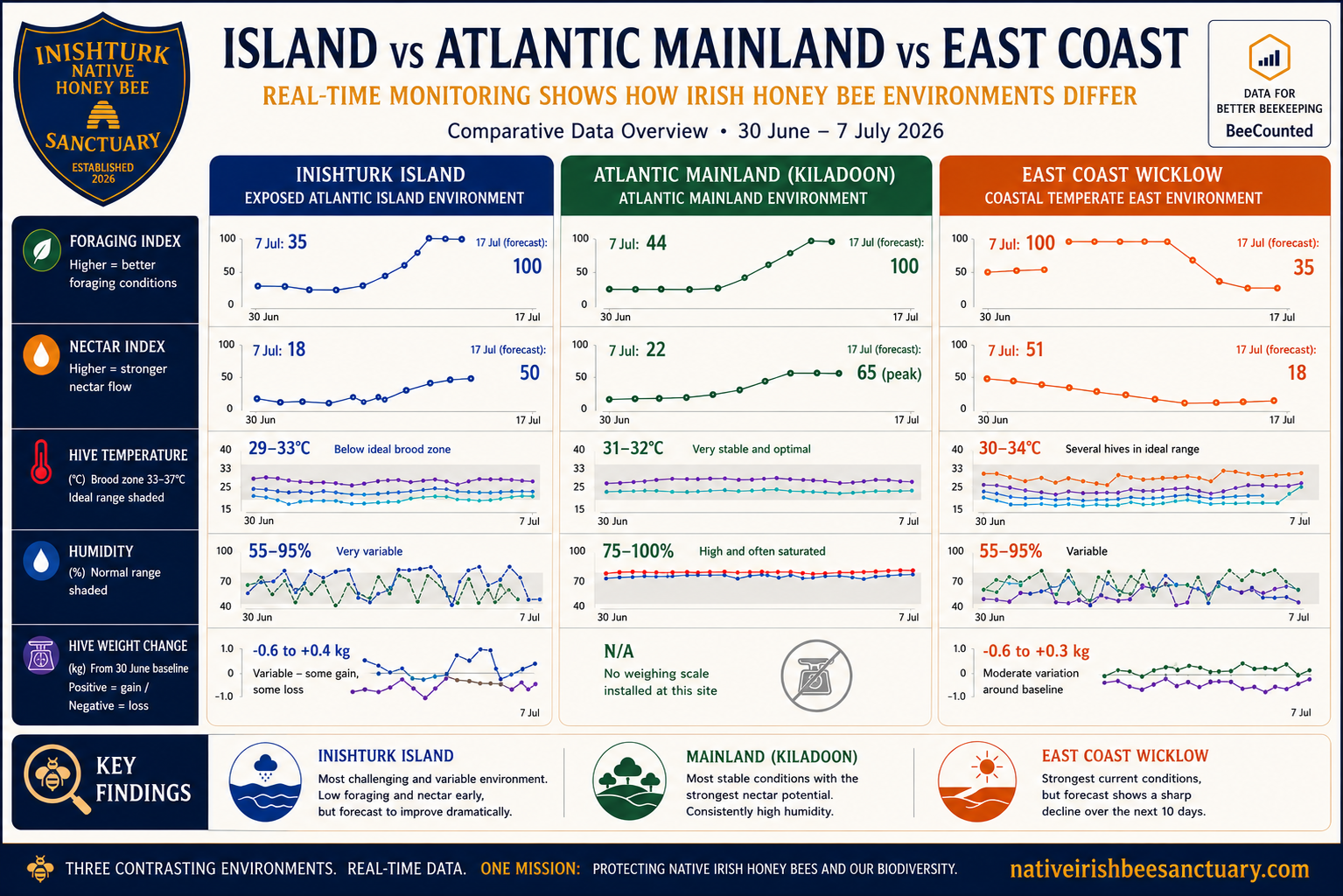
During the initial comparison period, the Inishturk Foraging Index stood at 35, compared with 44 in Mayo and 100 in Wicklow. The Nectar Index was 18, compared with 22 in Mayo and 51 in Wicklow.
However, the forecast data showed a dramatic change in conditions. The Inishturk Foraging Index was projected to rise to 100, while the Nectar Index was forecast to increase to approximately 50.
This rapid change illustrates one of the most interesting characteristics of the island environment: conditions can move from relatively challenging to highly favourable within a remarkably short period.
The monitored data also showed hive temperatures generally ranging between approximately 29°C and 33°C, while humidity was highly variable.
Inishturk also has hive weighing equipment installed, allowing changes in hive weight to be monitored alongside temperature, humidity and environmental conditions.
As monitoring continues, we hope to better understand how Native Irish Honey Bee colonies respond to the particular challenges of an exposed Atlantic island environment.
Mayo Mainland – Killadoon: The Atlantic Mainland Comparison
The Killadoon apiary provides an important mainland comparison with Inishturk.
Although both locations are situated on Ireland’s Atlantic coast, the data demonstrates that geographical proximity does not necessarily mean identical environmental conditions.
During the initial monitoring period, Killadoon recorded a Foraging Index of 44 and a Nectar Index of 22.
Like Inishturk, conditions were forecast to improve significantly, with the Foraging Index reaching 100 and the Nectar Index peaking at 65 — the highest nectar-flow potential recorded across the three locations during the comparison period.
The monitored colony temperatures appeared relatively stable, generally around 31–32°C, while external humidity remained consistently high.
There are currently no hive weighing scales installed at the Killadoon monitoring site. Therefore, no hive weight-change data is included for this location.
The Killadoon data provides an important reference point for examining the differences between an Atlantic mainland environment and the more exposed island conditions experienced on Inishturk.
East Coast Wicklow: A Contrasting Environment
The East Coast Wicklow apiary provides a valuable geographical contrast to the two Atlantic monitoring locations.
At the beginning of the comparison period, Wicklow experienced by far the strongest foraging conditions of the three locations.
The Foraging Index reached 100, while the Nectar Index was approximately 51.
However, the subsequent forecast showed a significant reversal.
While conditions on Inishturk and the Mayo mainland were improving, the Wicklow Foraging Index was forecast to decline to approximately 35, with the Nectar Index falling to approximately 18.
This contrasting pattern demonstrates the importance of monitoring multiple geographical locations simultaneously.
Excellent conditions in one part of Ireland may coincide with relatively poor conditions elsewhere — and those patterns can reverse within days.
Hive weighing equipment is also installed at the East Coast Wicklow apiary, providing additional data on changes in colony weight.
What Are We Learning?
Even at this early stage, the project is demonstrating the value of comparative, real-time environmental monitoring.
Three particularly interesting observations are emerging:
- Geographical variation: Honey bee colonies can experience significantly different foraging and environmental conditions across Ireland during the same period.
- Island versus mainland conditions: Despite their relative geographical proximity, Inishturk and Killadoon can experience different environmental conditions and patterns.
- Rapid environmental change: Foraging and nectar conditions can change dramatically over relatively short periods, particularly in exposed Atlantic environments.
These initial observations reinforce the importance of collecting data over multiple seasons and years rather than drawing firm conclusions from individual inspections or short monitoring periods.
An Ongoing Monitoring Project
This is very much a project in progress.
The Inishturk Native Honey Bee Sanctuary intends to continue collecting and comparing data across the three monitoring locations.
Over time, this will allow us to investigate longer-term patterns in colony conditions, temperature, humidity, weather, foraging opportunities, nectar availability and, where weighing equipment is installed, changes in hive weight.
As the dataset grows, we hope that it may contribute to a better understanding of how Native Irish Honey Bees respond to different Irish environments and changing climatic conditions.
Supporting Research, Education and Collaboration
A central objective of the Inishturk Native Honey Bee Sanctuary is to encourage education, research and collaboration.
We particularly welcome interest from students, postgraduate researchers, universities, schools, environmental organisations and other researchers who may wish to explore or analyse the data being collected through the project.
Where appropriate and subject to data availability, we are happy to discuss providing access to project data for legitimate educational and research purposes.
Students and researchers interested in accessing the data or discussing potential research collaboration are invited to contact: info@nativeirishbeesanctuary.com
Different Places. Different Conditions. Better Understanding.
By monitoring Native Irish Honey Bees across an Atlantic island, the Atlantic mainland and Ireland’s east coast, we are beginning to build a unique picture of how honey bee colonies experience Ireland’s diverse environments.
The project is still at an early stage. The data will grow. The comparisons will become more meaningful.
Over time, we hope this ongoing monitoring network will contribute to a better understanding — and better protection — of Ireland’s Native Honey Bees.